Taphonomy: Wednesday, August 28, 2019

I’ve spent the whole day today reading up on taphonomy, the study of the changes that influence a faunal or archeological deposit. The word was coined by the Russian palentologist Ivan Efremov in a 1940 issue of Pan-American Geologist, and literally means the “laws of burial.”
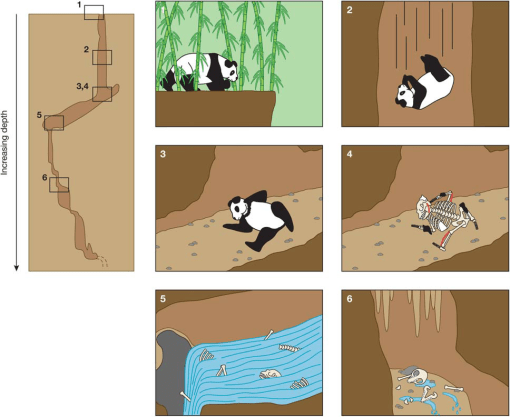
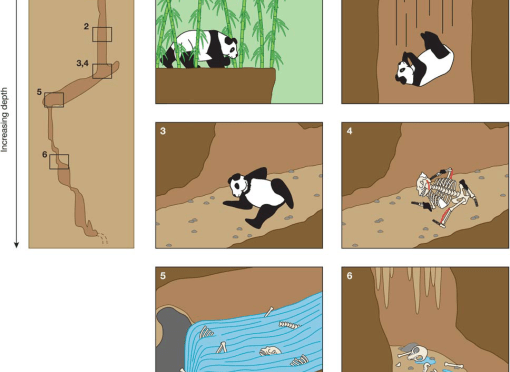
Figure 7. Possible taphonomic scenario resulting in the accumulation of giant panda bones in the lower chamber. Drawing by Jennifer Kane. From: Jablonski, N. G., J. Xueping, L. Hong, L. Zheng, L. J. Flynn, and L. Zhicai. 2012. Remains of Holocene giant pandas from Jiangdong Mountain (Yunnan, China) and their relevance to the evolution of quaternary environments in south-western China. Historical Biology 24:527-536.

All taphonomic models emphasize decline in the integrity of the buried remains, which occurs before, during, and after burial. Further decline in integrity occurs during excavation and archaeological biases, which can dictate what’s an “important” find and what’s not. It is a fascinating branch of science and I discovered super curious things today during my reading. 

So I’m reading one of the Cambridge Manuals of Archaeology titled simply Zooarchaeology(2005). From the book: 

“The deposited [faunal] assemblage contains the durable remains of animals either intentionally buried, thrown on a refuse heap, or lost at the site…Foot traffic across the [faunal] site crushes some of the refuse. The plant and animal refuse attracts scavengers and commensal animals. Animals, such as mice and land snails, find food and shelter at the site and their bodies become part of the assemblage if they die there, along with insects and botanical materials. Other animals living at the site, such as [an] owl roosting in [an] overhanging tree, regurgitate pellets of inedible animal remains that mingle with the debris related to human economic and social life.”

If you thought that was the end of it, we’re only beginning. After all of this happens, post-depositional processes further change the site. For instance plant roots and burrowing animals can alter and move the deposits from one place to another. Displacement also happens thanks to flowing water and wind, each of which carries sediments that can add to the deposit. Finally, as if you weren’t having enough fun yet, there’s something called tephra, which is a fancy word for volcanic ashes. Tephra can blanket and seal older deposits beneath more recent ones. 

Now what is really awesome about this is the things you can deduce. Sometimes you will find evidence of cooking but no bones. That’s because cooking shrinks bone, sometimes to the point where the bone completely disappears from the archaeological record. That’s crazy! The bones that do survive cooking will become brittle and appear white or light blue in color. I saw this at my first dig in a cave in Lyon, France. Bluish bone was recovered in modest amounts, evidence that cooking was being done inside the cave. 

The presence of horn, mollusk, shells, and turtle shells may signify the use of these as drinking vessels or bowls. And speaking of turtles, here’s an interesting tidbit: Sometimes turtles enter middens (refuse heaps) but there is no evidence of them. The way you deduce they were there is through the presence of commensals, such as barnacles and bryozoans, tiny invertebrate animals that are filter feeders. Both barnacles and bryozoans live attached to turtles and sea whales. So if you find barnacles or bryozoans at a site, you can deduce that a turtle (or sea whale!) must have passed or swum by!

Now a final note on commensals, this time land snails and house mice. Commensals are attracted to refuse heaps for food, moisture, and shelter. The presence of commensals at a refuse heap means the midden was left exposed to the elements for a long period of time. If there are no commensals, then this means that the pit “was filled rapidly, covering and protecting the refuse from disturbance and destruction by exposure to environmental forces (Armitage and West 1985; Reitz 1994a).”

Another thing that I found curious is how trampling can widely disperse an animal’s remains while leaving them scratched and broken. I can’t imagine walking over animal bones, but there you have it: Homo sapiens at its finest. Heavy foot traffic such as in a house, barnyard, or stable would be places where heavy trampling occurs. But the archaeologist has to be careful to distinguish trampling marks from marks made by the matrix in which the deposits are found. Again, from the Zooarchaeology book: 

“When the soil matrix is coarse and has large sand grains, such scratches are easily visible without magnification. However, if the matrix is soft material, such as dried leaves and pine needles, the specimen’s surface may be so polished that it is similar in appearance to worked bone. Attributing such abrasions to trampling may be incorrect because similar marks also are caused by sedimentary particles, aeolian processes, or aquatic transport (Gifford 1981; Shipman and Rose 1983a).” 

And let’s remember that plant roots can also leave marks on the specimens and burrowing animals can scratch and “rearrange” the position of the same. 

What’s interesting about taphonomy are their studies. These are called actualistic studies. I know of a taphonomist, for instance, who released the bones of cows at a section of a river in Wyoming and then followed them down to see where they ended up. People, however, can get very creative with these studies. Again, from the Zooarchaeology book: 

“In an experiment to document the impact of digestion on fish elements, Wheeler and Jones (1989: 69-75) fed fish to a dog, a pig, and a rat, as well as eating some themselves. They then collected the feces, sieved out the fish remains, and examined them for damage from chewing and digestion. The kinds of damage observed were then compared with those seen in an archaeological deposit of a latrine pit from Coppergate, York. This study of the survival rate of bone first fragmented by chewing and then exposed to digestive juices demonstrates that as much as 80 percent is lost.”  

To go through your own feces in the name of science shows dedication and passion. 

I’ve really had a wonderful day thus far reading about taphonomy, and this is definitely a branch of paleontology I would like to learn much more about. 
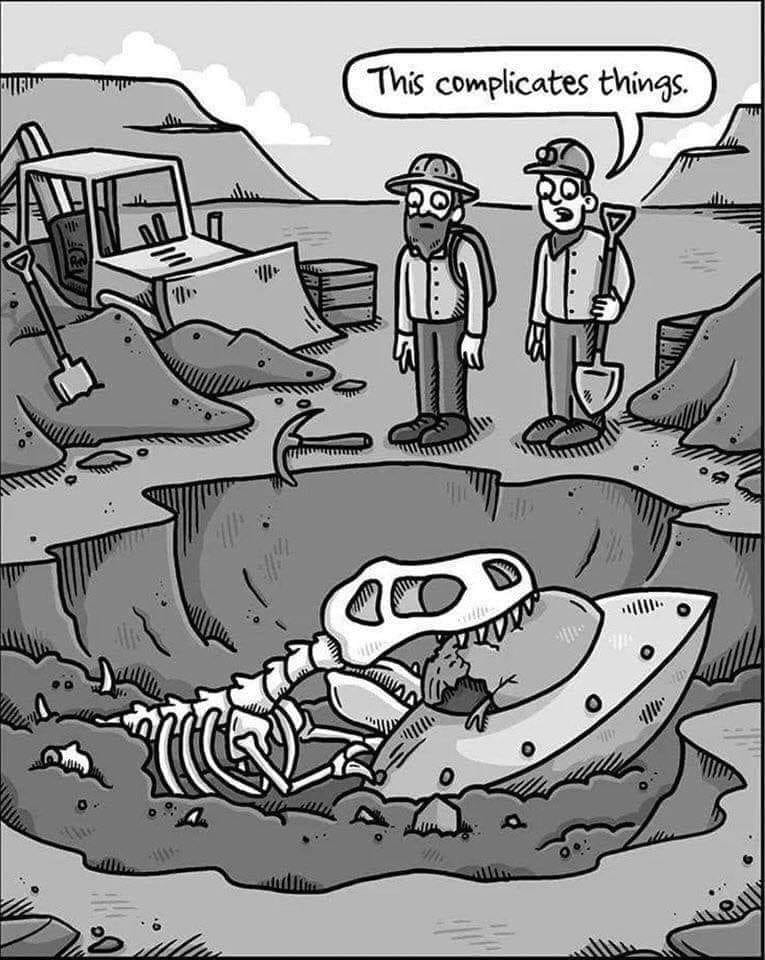
I wish I knew the author of this comic in order to give him/her credit.

Homo Religiosus: Sunday, August 25, 2019

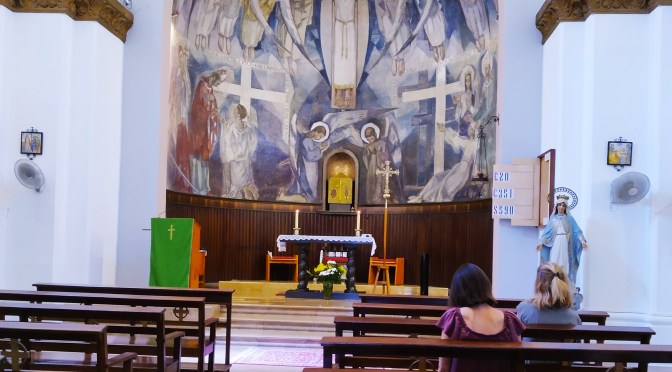
Today I attended a Catholic mass at Bellaterra’s church. The service was in Catalan, but in knowing Spanish, I was able to follow along. I’m not a practicing Catholic, and I haven’t been to confession in years. But I’ve always been fascinated by religion from the point of view of cultural anthropology. Man’s need for ritual has held my attention since I was a kid. Mircea Eliade, a Romanian historian of religion and an anthropologist/sociologist, coined the term Homo religiosus to mean that man has always yearned for the sacred. This yearning can be broken down into four beliefs:

1) A belief in a transcendent reality;

2) A belief that the Sacred wants to connect with human beings;

3) A belief that when the Sacred enters a place, it makes it holy. Once a place is holy, a human being can enter it and become holy him/herself;

4) A need to celebrate and recount myths. In doing so, Homo religiousus enters “sacred time” and remembers what Eliade calls “paradigmatic models”–lessons in how to be a good person, what values and virtues to cultivate, what vices to avoid. In this celebrating and recounting of myths, Homo religiosus enters sacred time again and again to discover and re-discover his/her purpose in life.
These four beliefs have been paraphrased from here.

In Chapter 4 of The Sacred and the Profane, Eliade writes:

What we find as soon as we place ourselves in the perspective of religious man of the archaic societies is that the world exists because it was created by the gods, and that the existence of the world itself “means” something, “wants to say” something, that the world is neither mute nor opaque, that it is not an inert thing without purpose or significance. For religious man, the cosmos “lives” and “speaks.” The mere life of the cosmos is proof of its sanctity, since the cosmos was created by the gods and the gods show themselves to men through cosmic life.

The inner patio of the church is well-taken care of as you can see by the lushness of the plants.

Geneticist Dean Hamer proposed the existence of a “God gene,” meaning that we’re genetically predisposed to have spiritual or mystical experience. He studied over a 1,000 people and singled out the gene VMAT2 for predisposing individuals to mystic experiences and the feeling of the presence of God. This gene is responsible for regulating serotonin, dopamine, and norepinephrine. In turn, these neurotransmitters are hypothesized to cause mystical and spiritual experiences in individuals. He believes that having these mystical experiences gives people the will needed to live life fully in the face of death.

This has been an extremely controversial hypothesis because it has been based on one, unreplicated study. Plus, this gene can make you believe in anything, as New York Times science journalist Carl Zimmer pointed out here. Personally, I find the hypothesis fascinating and would love to see whether the study could be replicated. I would suppose that Dean Hamer is today’s scientific exemplar of Homo religiosus, in that he’s looking for a scientific reason for why so many people believe in God and religion.

It was wonderful to attend the service and view it, for the first time, as an anthropological experience instead of as a purely religious experience as I did as a kid. I had a couple sitting across from me that were in full devoted prayer the entire time I was there. My heart went out to them because they were clearly troubled and were asking for divine help.

Skeleton Lake: Thursday, August 22, 2019

Roopkund Lake, which sits atop the Himalayas at 16,500 feet above sea level, is also known as Skeleton Lake and for good but macabre reasons. The lake is frozen most of the year but when it thaws, hundreds of skeletons emerge.

The skeletons were initially discovered by a forest ranger in 1942, who concluded they were invading Japanese soldiers from World War II. But local folklore has a more colorful explanation. There is a nearby shrine for the mountain goddess Nanda Devi. A king and his queen led a pilgrimage with their attendants, but when Nanda Devi saw how raucous they were in their exultant celebratios, she decided to strike them down. A few years ago, a group of archaeologists concluded that the skeletons belonged to a group of travelers from the ninth century who were struck down by a lethal hailstorm, since many of the skulls show blows to the head.

But a new study has yielded even more puzzling results. The skeletons belong to travelers spread over a 1000 years. There are individuals of South Asian origin dating from the 7th to the 10th century. But then, there are individuals of eastern Mediterranean origin–along with an individual of East Asian origin–dating from the 17th to the 20th century. The natural question is: what were individuals from the eastern Mediterranean doing so far from home and why?

One answer is early ecological tourism. Perhaps news of Roopkund Lake had traveled all the way to Europe and some people decided to pay it a visit.

This explanation, however, does not sit well with Kathleen Morrison, chair of the department of anthropology at the University of Pennsylvania. She calls attention to the fact that a Hellenic kingom existed in India for about 200 years, beginning in 180 B.C. She also points out that radiocarbon dating gets less and less accurate the closer we get to the present day, implying that the date between the 17th to the 20th century of the eastern Mediterranean individuals is wrong. To her, this massive amount of skeletons can only mean one thing: it’s a graveyard.

Regardless of whether the site was a massive dumping ground for the dead, the recent study also discovered that the individuals included both children and the elderly, but mysteriously, none were family relatives. To me, this is evidence that the skeletons belong to pilgrims. However, a search for travelogues and written accounts of journeys or pilgrimages has proved unfruitful. And the mystery remains and deepens.

Featured image was taken by Atish Waghwase.

Photograph by Awanish Tirkey.


Blue Hour and W. B. Yeats: Tuesday, August 20, 2019

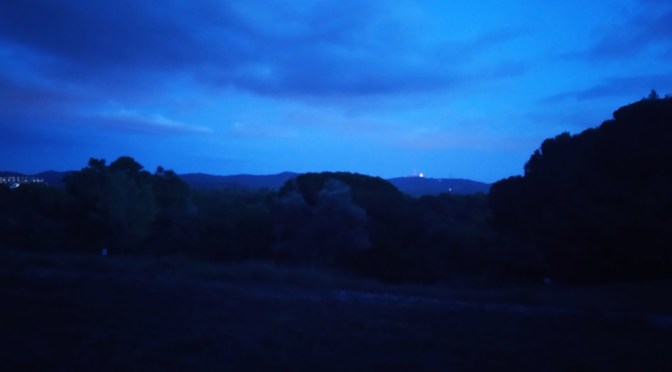
It is now one of my two favorite times of the day: twilight. Celtic lore holds that the “veil” between the human world and the fairy world “lifts” during these magical times of day, allowing for fairies to be seen by humans. I’ve investigated what gives twilight its magical blue color in the sky. It turns out that during morning and evening twilight, the Sun is from 4 to 8 degrees beneath the horizon. During these times, the Sun’s blue wavelengths dominate because the ozone layer absorbs the  yellow, orange, and red parts of the light spectrum. This kind of absorption is known as the Chappuis absorption, named after the French chemist James Chappuis. As a result, a magical teal color dominates the sky. The sun sets pretty late here in Barcelona, at aroun 9 p.m. I say late because I’m used to the sun setting at 6:30 p.m. in Puerto Rico, where I’m from. Photographers love to take photos during the blue hour because the blue light is magnificent, as you can see here. It’s almost as if they’re hoping to catch a fairy.

W.B. Yeats once wrote: “At Howth, a great colony of otherworld creatures travel nightly.” The Irish Times has a great article about fairies still living in the Irish imagination. From the article and being quoted from Irish Fairies (1890) by W.B. Yeats:

“When I tell people that the Irish peasantry still believe in fairies, I am often doubted. They think that I am merely trying to weave a forlorn piece of gilt thread into the dull grey worsted of this century. They do not imagine it possible that our highly thought of philosophies so soon grow silent outside the walls of the lecture room, or that any kind of ghost or goblin can live within the range of our daily papers. If the papers and the lectures have not done it, they think, surely at any rate the steam-whistle has scared the whole tribe out of the world. They are quite wrong. The ghosts and goblins do still live and rule in the imaginations of the innumerable Irish men and women, and not merely in remote places, but close even to big cities. 

At Howth, for instance, ten miles from Dublin, there is a ‘fairies path’, whereon a great colony of otherworld creatures travel nightly from the hill to the sea and home again.”